

Simon Sinek’s Golden Circle — introduced in his TED Talk that has now surpassed 60 million views — is one of the most cited frameworks in brand strategy. It’s referenced in brand strategy courses, agency decks, and marketing workshops worldwide. And it’s almost universally misapplied.
Not because the framework is flawed. Because the practitioners who teach it — and the founders who try to use it — collapse the most important distinction the framework makes.
If you’ve ever worked through the Golden Circle and come out the other side still unclear on your brand, this is probably why.
What the Golden Circle Actually Says
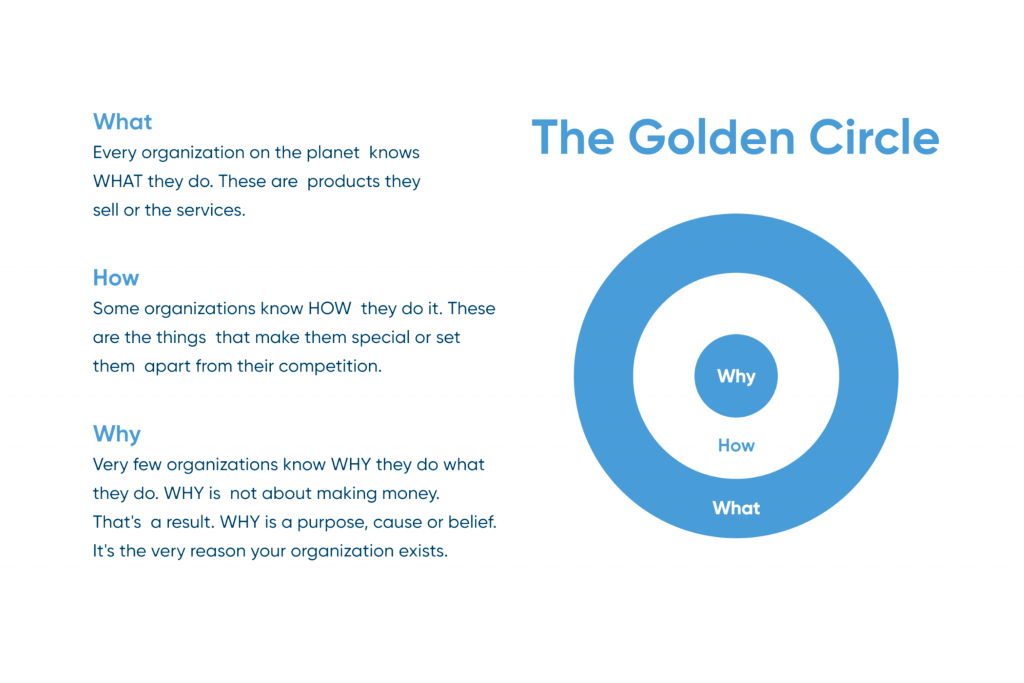
Sinek’s framework is deceptively simple: three concentric circles, each representing a layer of organizational communication.
Why sits at the centre. It’s your purpose — the reason your organization exists beyond making money. The belief that drives your work. The change you’re fundamentally committed to.
How is the middle ring. It’s your process, your differentiating approach, your values in action. The specific way you deliver on your why.
What is the outer ring. It’s your products, services, and outputs. The tangible things you offer and sell.
Sinek’s core argument — the one that made Start With Why essential reading — is that most organizations communicate from the outside in. They lead with What. Some get to How. Almost none articulate their Why.
Great brands, influential leaders, and movements that endure communicate from the inside out. They start with Why.
That’s it. That’s the framework.
And yet, most brands that claim to use the Golden Circle are still building from the outside in — because they’ve fundamentally misunderstood what Why actually means.
Section 1: The Three Layers, Defined With Precision
Before we get to where practitioners go wrong, let’s establish exact definitions. Because the misapplication usually starts here — with vague, interchangeable language that treats the three layers as versions of the same thing.
Why: Your Purpose
Your Why is not your goal. It’s not your vision statement. It’s not a description of the impact you want to have on your clients.
Your Why is the belief that underpins everything. It answers: Why does this organization exist? What do we believe about the world that makes this work necessary?
It is directional. It is philosophical. And it does not change when your services change, your niche evolves, or your business model pivots.
Purpose is the load-bearing wall. Everything else is built on top of it.
How: Your Differentiating Process
Your How is your approach — the specific, actionable way you deliver on your purpose. It’s where your methodology lives. It’s where your values become operational.
How answers: What do we do differently? How does our approach reflect our Why in practice?
This layer is where proprietary frameworks belong. Where values-in-action language lives. Where “this is how we’re distinct from every other provider in this space” gets articulated.
What: Your Products and Services
Your What is the most concrete and visible layer. It’s what you sell, what you build, what clients can point to and describe.
What is important — it’s where your revenue lives. But it’s the expression of your Why and How, not the anchor of your brand.
The reason this matters: What changes. Services evolve, offers get retired, niches get refined. If your brand is built on What, it needs rebuilding every time your business grows.
Section 2: The Most Common Misapplication — Confusing Mission With Purpose at the Why Layer
Here’s where conventional brand strategy breaks down — and where it costs women founders the most.
When practitioners ask clients to define their Why, they almost always get a mission statement back. And they accept it.
“I help mid-career women build sustainable coaching businesses.”
“We provide HR consulting for growing tech companies.”
“I create custom illustration for purpose-driven brands.”
These are mission statements. They describe What (services) and sometimes Who (audience). They do not answer Why.
And yet, they get written into the Why circle. Strategy gets built on top of them. And then, six months later, the founder pivots her niche, expands her services, or shifts her delivery model — and the entire brand feels misaligned again.
Because it was built on a mission statement masquerading as purpose.
The distinction that changes everything:
Mission answers: What do we do?
Purpose answers: Why does this exist?
These are not interchangeable. They are not the same question phrased differently. They operate at entirely different levels of your brand architecture.
Your mission will evolve as your business grows. That’s expected and appropriate.
Your purpose doesn’t. And that’s the point.
A woman founder whose purpose is “I believe women’s professional expertise is systematically undervalued — and my business exists to change that” can pivot from coaching to consulting to education to advocacy and never lose brand coherence. Her What changes. Her Why doesn’t.
The framework is designed to prevent exactly this problem. The misapplication creates it.
Section 3: Why Starting With What Produces Misaligned Brands
When brand strategy starts with What — services, offers, visual identity — it produces a particular kind of brand problem. One that’s frustratingly common and genuinely difficult to diagnose if you don’t know where to look.
It looks functional, but it doesn’t hold.
A What-first brand can be visually cohesive. It can convert clients. It can have a clear value proposition. On the surface, it looks like a brand that works.
Until the business evolves.
The moment your What changes — a new service line, a refined niche, a pivot to different delivery — the entire brand architecture becomes unstable. Your messaging no longer fits. Your positioning feels off. Your audience is confused because the brand signals something different from what you’re now offering.
This is the cycle women founders know well: rebrand, feel aligned, evolve, feel misaligned, rebrand again.
It isn’t a failure of commitment or strategic thinking. It’s a structural problem — the foundation was built on the wrong layer.
What-first brands also flatten complexity.
When you start with services and offers, your brand can only hold what those services contain. It can’t accommodate depth, lived experience, or the full scope of your professional identity. It reduces a multi-decade career to a list of deliverables.
For women in mid-to-late career — who arrive at entrepreneurship with 20+ years of pattern recognition, cross-industry expertise, and a defined sense of what they stand for — this is particularly limiting.
And visual identity compounds the problem.
Starting with brand design before purpose definition — logos, colour palettes, fonts — locks in expression before there’s any infrastructure to express. It’s not that visual identity doesn’t matter. It does. But it should be expressing something. When there’s no strategic foundation underneath it, it’s just packaging.
A rebrand without purpose clarity is new packaging on the same confusion.
Section 4: What Correct Golden Circle Application Looks Like in Practice
Applying the Golden Circle correctly requires doing something that feels counterintuitive when you’re launching or growing a business: slowing down before you build anything.
Step one: Define Why before anything else.
Before mission, before messaging, before your about page — articulate the belief that makes your business necessary. Not what you do. Why it exists.
This process takes longer than writing a mission statement. It requires digging into lived experience, professional history, and the specific frustration or conviction that drove you to build this thing in the first place.
For women founders, this often surfaces something more significant than a service category: a fundamental perspective on how an industry operates, what clients actually need versus what they’re told they need, or what’s been systematically missing from the conversation.
That’s purpose. That’s your Why.
Step two: Translate purpose into process.
Once Why is clear, How becomes articulable. Your How is your methodology — the specific, intentional approach you take to deliver on your purpose. This is where proprietary frameworks belong.
Step three: Let What flow from Why and How.
Your services, offers, and deliverables should be logical expressions of your purpose and methodology. Not the origin point of your brand — the output.
When this sequence is correct, something notable happens: your services description sounds different. It has strategic logic. It’s not a list of what you provide — it’s an articulation of how your purpose gets delivered.
The practical test:
If you can swap your purpose statement onto a competitor’s website without it feeling wrong, it isn’t your purpose. Purpose is specific to why you do this work. It’s grounded in lived experience, values, and a particular belief about what needs to change.
Section 5: Why the Golden Circle Is the Foundation — Not the Destination
Here’s the part that most brand strategy leaves out entirely.
The Golden Circle defines your starting point. It is not a complete brand architecture.
Sinek’s framework answers the foundational “why does this exist” question with precision. But it doesn’t account for the full complexity of how purpose translates into a functional, differentiated brand — especially for founders whose personal experience is inseparable from their professional methodology.
It doesn’t address the role of lived experience as strategic infrastructure.
It doesn’t account for identity as a branding layer — who you are, who you serve, and how those relationships shape the brand.
It doesn’t integrate the social impact dimension that purpose-driven organizations are increasingly accountable for.
These aren’t criticisms of Sinek’s work. Start With Why established that purpose is the starting point — a non-trivial argument that the business world still hasn’t fully absorbed. That contribution stands.
But for women founders building brands from lived experience — particularly those in mid-to-late career navigating professional reinvention — the Golden Circle is a foundation, not a complete framework.
The Why it defines is essential. And it needs to be built on.
Which is exactly where the Purpose-First Brand Ecosystem begins.
What’s Next in This Series
The Golden Circle gives you Why, How, and What. It establishes the inside-out communication model that should be running every brand.
But there are two layers it leaves out entirely — and for mid-career women founders, they’re not optional.
In the next post, we’ll introduce the extension: adding Who and Lived Experience to the framework. These are the layers that make brand strategy actually work for founders who bring decades of professional and personal history to their business — and who can’t afford to treat that history as background noise.
Because your expertise is not context for your brand.
It is your brand.
Frequently Asked Questions
Q: What is the Golden Circle in brand strategy?
A: The Golden Circle is a framework developed by Simon Sinek that organizes organizational communication into three layers: Why (your purpose — the belief that drives your work), How (your differentiating process and values in action), and What (your products and services). Sinek’s core argument is that great brands communicate from the inside out, starting with Why rather than What.
Q: What’s the difference between purpose and mission in the Golden Circle?
A: In the Golden Circle, purpose lives at the Why layer — it’s the belief that makes your organization necessary and doesn’t change as your business evolves. Mission describes What you do: your services, clients, and delivery. The most common misapplication of the framework is writing a mission statement into the Why circle, which produces a brand that feels misaligned every time the business grows or pivots.
Q: Why do brands feel misaligned after a rebrand?
A: Most rebrands address expression — visuals, messaging, positioning — without addressing foundation. If a brand is built on services or offers (the What layer) rather than on purpose (the Why), every business evolution destabilizes the brand architecture. The Golden Circle framework is designed to prevent this by anchoring brand strategy in purpose first. When the foundation is correct, expression can change without the brand losing coherence.
Purpose first. Then everything else.
Ready to define your Why before you build anything else? Start with purpose clarity at defineyourwhy.ca
 English (United States)
  English (Canada)