

The Golden Circle is a powerful foundation but for mid-career women founders, it needs two more layers.
In the last post, we looked at the Golden Circle — what Simon Sinek actually said, why almost everyone applies it incorrectly, and why that gap costs women founders the brand clarity they deserve.
But here’s the thing: even when the Golden Circle is applied correctly, it’s still incomplete.
Not because Sinek got it wrong. Because he wasn’t writing for women in mid-to-late career who arrive at entrepreneurship with 20, 25, 30 years of lived professional and personal experience behind them. The Golden Circle is a powerful framework. It’s also a starting point, not a destination. And for the women Pronoia serves, it needs to go further.
The gap inside the Golden Circle
Start With Why is built around organizations and their leaders — specifically around the question of how purpose-driven communication moves people. Sinek’s examples are Apple, Southwest Airlines, Martin Luther King Jr. The framework is powerful.
What it wasn’t designed to address: the founder herself.
The Golden Circle tells you to start with Why. It doesn’t ask whose Why. It doesn’t account for the decades of experience, pattern recognition, identity formation, and values clarification a mid-career woman founder brings to her Why definition. It doesn’t create space for the non-linear career path, the portfolio of expertise across sectors, the personal transformation that drove the professional decision to build something of her own.
Those aren’t footnotes to your brand strategy. They’re load-bearing.
So at Pronoia, we extend the Golden Circle with two additional layers: Who and Lived Experience. Not as soft additions. As strategic infrastructure.
The first missing layer: Who
In the original Golden Circle, the question of audience — who you serve, who you are, how your identity intersects with your work — doesn’t get its own layer. It’s implied, folded into the What. That’s a structural problem for founder-led brands, where the founder is the brand at its origin point, and where the relationship between identity and strategy is not incidental but foundational.
The Who layer has two dimensions.
The first is founder identity: who you are as the person building this business. Your professional formation. The roles you’ve held and outgrown. The sectors you’ve worked across. The expertise that accumulated not through one linear climb but through a series of experiences that look messy from the outside and pattern-rich from the inside. This isn’t biography — it’s brand infrastructure.
The second is relational context: the intersection between who you are and who you serve. Not just your target audience demographics, but the why of that audience choice. Why these clients, specifically? What connects your lived formation to their actual need? What makes you the right person, with the right accumulated understanding, to serve them well?
For mid-career women founders, this layer is often where the most powerful brand differentiation lives — and where conventional brand strategy consistently fails to look.
You are not interchangeable with a 28-year-old brand strategist who took a course. You have pattern recognition they haven’t had time to develop. That is not a soft differentiator. It is a strategic asset that belongs in your brand foundation.
The Who layer is where that asset gets named, defined, and built into the architecture.
The second missing layer: Lived Experience
This is where Pronoia’s framework diverges most sharply from conventional brand strategy — and where the work gets most specific to the women this methodology is designed for.
Conventional brand strategy treats your personal history as context. Background. Something to mine for your ‘origin story’ paragraph, then move past. The frameworks are designed to be transferable, replicable, industry-agnostic. Your particular experience of the world isn’t supposed to matter — or rather, it’s supposed to matter only insofar as it makes for a compelling narrative.
That’s not how purpose works.
Your purpose doesn’t emerge from a workshop exercise. It doesn’t come from picking the most resonant option off a values list. It emerges from the specific accumulation of your experience — what you’ve seen that others haven’t, what’s frustrated you enough to commit to changing it, what you’ve survived that taught you something about what actually matters.
The Lived Experience layer makes that material explicit and strategic.
For the women Pronoia works with — those of us who’ve spent 20-plus years in corporate environments, navigated career reinvention, raised families while building professional identities, experienced the particular clarification that comes from major life transitions — this layer is often the richest source of brand differentiation available.
Not because your story is unique in the sense of being unprecedented. Because it’s specific. And specificity is what brand strategy almost never asks for.
Lived Experience, in the Purpose-First Brand Ecosystem, means treating your specific history not as decoration — a warm story to soften your marketing — but as the strategic source material your purpose is actually built from. That’s what makes your brand impossible to replicate.
Why these layers matter specifically for mid-career founders
When you’ve been in the workforce for 20 years, your expertise is non-linear. You’ve worked across sectors, functions, life stages. From the outside, that can look like a liability — too broad, no clean niche, hard to summarize.
From the inside, it’s the thing that makes you exceptional at what you do. Pattern recognition across domains. Systems thinking built from actual systems experience. The ability to see connections your clients can’t see because they’re too close to their own situation.
The Golden Circle asks: What is your Why? The extended framework asks: What specifically did you live through that created that Why? Who are you, in the fullness of your professional formation, and how does that shape who you serve?
These aren’t deeper questions in a philosophical sense. They’re more strategic questions. They produce answers that are harder to copy, harder to dilute, and far more durable as brand foundations.
The women who rebrand every two years aren’t doing it because they’re indecisive. They’re doing it because their brand was built on a generic framework that had no container for the most valuable things they bring to their work.
Adding the Who and Lived Experience layers to your brand foundation is how you stop starting over. It’s how you build something that can hold you — not just where you are right now, but as you continue to evolve.
Five Layers. One Architecture.
The extended framework looks like this, as it functions within the Purpose-First Brand Ecosystem:
Each layer informs the one above it. Your Lived Experience shapes your Who. Your Who deepens your Why. Your Why drives your How. Your How defines your What.
This isn’t a checklist. It’s an architecture.
When all five layers are defined with clarity and specificity, your brand stops being an expression of what you do. It becomes a reflection of why you are exactly the right person to do it.
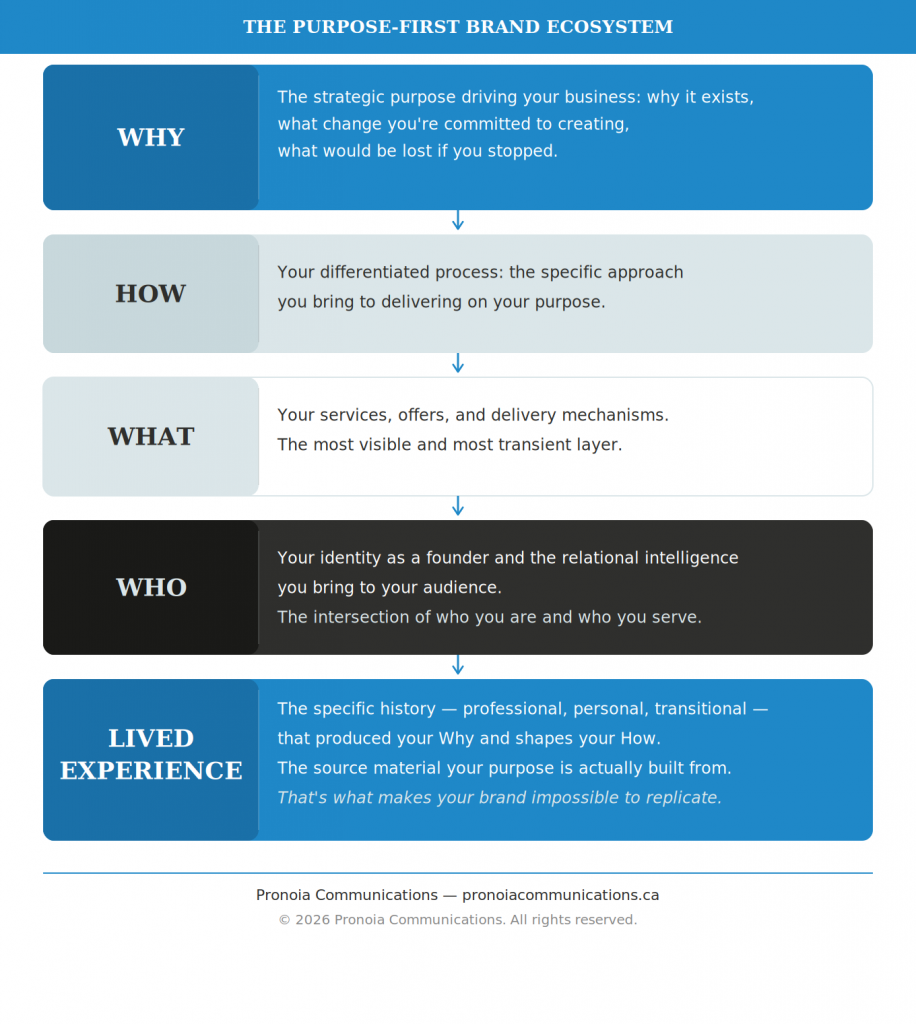
Each layer informs the one above it. Your Lived Experience shapes your Who. Your Who deepens your Why. Your Why drives your How. Your How defines your What.
This isn’t a checklist. It’s an architecture.
When all five layers are defined with clarity and specificity, your brand stops being an expression of what you do. It becomes a reflection of why you are exactly the right person to do it.
Next in the series: Values as infrastructure — not a list of aspirational nouns, but the structural connective tissue between your purpose and your brand expression.
Follow this series for the full Purpose-First Brand Ecosystem framework — or start with purpose clarity at defineyourwhy.ca
 English