

For most of your career, someone else defined the role. The title. The scope. The behaviors that got rewarded and the ones that got quietly corrected. Corporate structures are efficient that way — they don’t ask who you are. They tell you who to be, and you adapt, because that’s how you keep the job, lead the team, get the promotion.That works, for a while. Then you leave to build something of your own, and the question changes completely. Nobody’s defining the role anymore. You are. And that’s a much harder question than “what services do I offer” — it’s what kind of leader am I actually choosing to be now, on my own terms. This is the recognition work — grounded in the Inner Development Goals — that has to happen before you can answer that question honestly.
Most brand strategy has no room for that question at all. It asks what you do and who you serve. It doesn’t ask who you’re becoming now that you’re finally the one deciding.
Where This Fits in the Five Layers
In the last two posts, we laid out the architecture: the Golden Circle’s Why, How, What, extended with Who and Lived Experience — five layers, each informing the one above it. Lived Experience shapes Who. Who deepens Why. Why drives How. How defines What.
This post isn’t a sixth layer. It’s the work that happens inside Lived Experience and Who — the step where the raw material of your story gets excavated and converted into something you can actually build on.
Here’s the gap that step closes. Lived Experience gives you the raw material — the decisions, the moments, the things you survived. But a story on its own doesn’t tell you what it reveals. Two founders can describe nearly identical moments and be demonstrating completely different things: one shows courage, another shows discernment, a third shows systems-level thinking about risk. The story doesn’t announce which. You have to recognize it.
That recognition is what makes Who and Lived Experience actually functional as brand infrastructure, instead of just a more interesting bio.
Why Purpose Alone Doesn’t Answer This
Your Purpose Statement tells you why your business exists. That’s the Why layer, and it’s foundational — but it’s not the same as knowing what kind of leader you’re growing into as you run it.
Why is the belief. This work is about the person holding it — specifically, the leader doing the leading. And for founders who spent twenty-plus years inside corporate roles or traditional structures, that person was shaped as much by what the role permitted as by who they actually are. Some capacities got exercised constantly — diplomacy, execution, managing up. Others sat unused for years, because the role never called for them, or because using them would have made you harder to manage.
Starting your own business is often the first time in decades those unused capacities get to matter.
Two Directions, Both Necessary
This recognition works in two directions at once, and both matter.
Backward-looking: what capacities have you already demonstrated, even if no job title ever asked you to name them? The systems-level thinking you used to navigate a reorg nobody explained. The resilience that helped you return to work after a health crisis. The courage it took to leave a role that had stopped fitting years before you admitted it. These aren’t soft-skill footnotes. They’re evidence — the same evidence your Lived Experience layer is already built from.
Forward-looking: who are you deliberately choosing to become, now that you’re the one setting the terms? Not the leader a corporate structure needed you to be — the leader your Why is asking you to grow into. This is the more radical part, and it’s where many women at this stage of reinvention haven’t had room to ask the question honestly before.
Both halves matter. The backward-looking half keeps this grounded in real evidence, not aspiration dressed up as identity. The forward-looking half is what makes it a choice, not just a recap of your résumé.
Understanding the Inner Development Goals
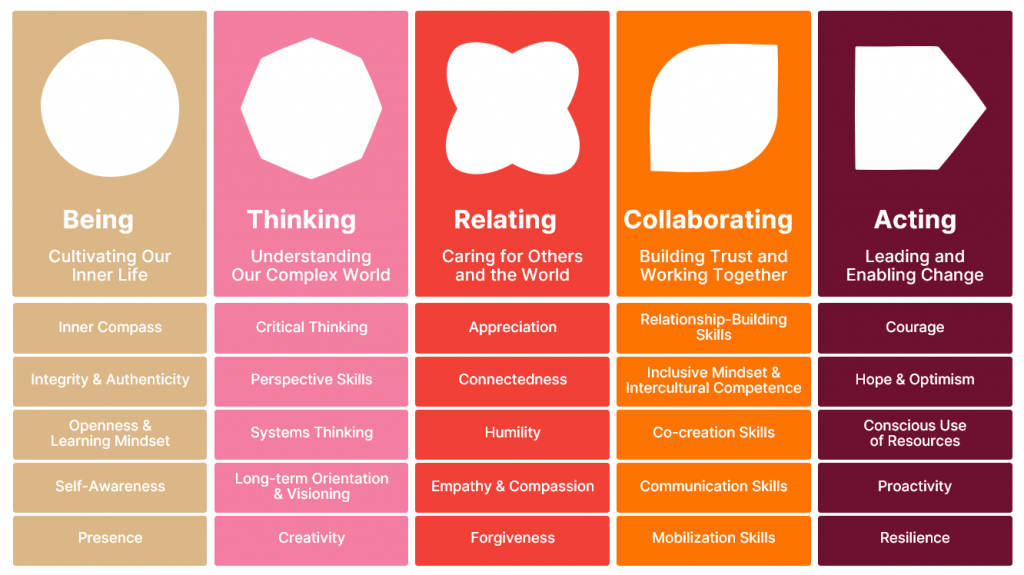
There’s a well-established framework we use to organize this recognition — the Inner Development Goals, which group human capacity into five areas: how you relate to your own values and self-awareness, how you think through complexity, how you relate to others, how you build trust and collaborate, and how you act and lead change.
The point of naming these isn’t to sort yourself into categories. It’s that Why tends to stay vague until you can say specifically which capacity of yours is actually doing the work of carrying it. “I want to help women feel less alone in business” is a nice sentiment. “I lead with connectedness — I notice isolation before people name it themselves, and I’ve built my entire client relationship around closing that gap” is a Why you can build a business on. Same belief. Completely different level of clarity, because now there’s a real capacity underneath it instead of just an intention. You don’t need to learn the framework to benefit from the recognition. What matters is being able to say this is a capacity I already have. This is one I’m choosing to grow into.
Why This Comes Before Values, Not After
Once this recognition is in place, values work stops being a guessing exercise. A value only lands when it’s attached to a specific leader-identity — not a generic virtue, your version of it, grounded in a capacity you’ve already shown and a person you’re actively becoming. Skip this step, and values end up floating: technically accurate, but disconnected from anything that would hold up under pressure.
This is also why the Core Values Alignment is built to draw on this same recognition. If you’ve completed your Purpose Clarity Coaching, your Impact Lens from this module carries forward into the values work, so the value you name isn’t disconnected from the leader you’ve already started to see yourself becoming; Lived Experience and Who inform Why, and this recognition work is what lets Why inform How — the values layer we cover next in the Purpose-First Brand Ecosystem.
Why This Matters Especially Now
If you spent decades being shaped by a role you didn’t design, this is where that stops. Not because the past doesn’t count — it does, it’s the evidence — but because for the first time, you get to decide which parts of who you were to keep leading, and which capacities finally get room to develop on your terms.
That’s not a branding exercise. That’s the actual foundation everything else in your Purpose-First Brand Ecosystem gets built on.
Next in the series: Once this recognition is in place, values stop being a list to choose from. In the next post, we look at why values are the architecture your entire brand stands on — not a set of words, but a decision filter grounded in exactly this work.
Frequently Asked Questions
Q: Is this a sixth layer in the Purpose-First Brand Ecosystem?
A: No. The framework has five layers — Why, How, What, Who, and Lived Experience. This is the recognition work that happens inside the Who and Lived Experience layers, converting your story into something specific enough to build Why and How on.
Q: Is this a personality assessment?
A: No. Personality frameworks sort you into a fixed type. This is about recognizing capacities you’ve already demonstrated in your own story, and naming the ones you’re intentionally choosing to grow — it’s evidence-based and forward-facing, not a category you are assigned to.
Q: What if I can’t tell which capacities are really mine versus what my old role trained into me?
A: That’s exactly the right question to be sitting with. The backward-looking reflection helps separate the two — capacities you demonstrated even when the role didn’t ask for them are the ones most likely to be genuinely yours.
Q: Why does this come before values instead of after?
A: Because a value needs something specific to attach to. Naming “courage” only means something once you’ve seen the courage in your own story and named the leader you’re becoming. This recognition is what makes that possible.
Why first. Then the leader your Why is asking you to become. Then values.
Next in the Series: Read Post 05: Values Are Not a List — They Are the Architecture Your Brand Stands On
Follow this series for the full Purpose-First Brand Ecosystem framework — or start with purpose clarity at defineyourwhy.ca
Tess Zevenbergen is a brand strategist and the founder of Pronoia Communications. She specializes in purpose-first brand strategy for women founders in mid-to-late career — helping them build brand ecosystems rooted in their strategic why, not just their services. Her methodology extends Simon Sinek’s Golden Circle with the Who and Lived Experience layers that conventional brand frameworks leave out. pronoiacommunications.com